In Whistler, Ann Patchett follows the strange afterlives of love, memory, and those people whom time was supposed to have taken from us.
There are people whom we lose so thoroughly that, after a sufficient number of years, the loss itself begins to acquire the quietness of furniture; it remains in the room, certainly, you know where it stands and may even glance towards it now and then, but you have learnt how to move around it in the dark without disturbing the dust on its surface. What you do not expect, having accomplished this small domestic arrangement with grief, is to encounter the person again in the Metropolitan Museum of Art, grey-haired now and elderly, following you through the galleries because some ancient part of him has recognised, in the woman you have become, the child you ceased to be nearly half a century ago.
This is how Ann Patchett begins Whistler, with a reunion whose emotional terms have been left unresolved for forty-four years and for which neither affection nor good manners can supply the proper etiquette. Daphne is fifty-three when she encounters Eddie Triplett, the man who had been briefly married to her mother when Daphne was nine; Eddie is old, Daphne herself has grown older than her mother was during their marriage, and whatever relation persists between them has long since wandered beyond those useful little words by which families are ordinarily arranged and explained. They have not been stepfather and stepdaughter for most of Daphne’s life, they have not been friends, and yet Eddie sees her and calls her “Duck,” the childhood name preserved in his memory long after she had ceased to imagine that anybody still remembered it.
There is something so moving in that small word, with its childish roundness and the old affection still clinging to it, because Daphne discovers within it that the past has not been lying forlornly where she left it. It has continued elsewhere, beyond the limits of her knowledge, accumulating years and losses of its own; Eddie has gone on being the person who once knew her as Duck, carrying that little girl within himself while she grew away from the house, the marriage and the brief arrangement of people to which the name belonged.
Patchett has always been drawn to attachments which survive the endings allotted to them, though she allows reunion very little consoling magic here. Eddie’s return adds an unforeseen portion to their shared history while leaving everything that preceded it untouched: he cannot become the young man who once belonged to Daphne’s household, Daphne cannot oblige him by becoming the child he remembers, and the forty-four years between them retain all their distance. They are given the harder and more interesting task of discovering what remains between two people after the relation that once joined them has disappeared, and whether affection interrupted for almost half a century can still find some altered place in the lives that continued without it.
Whistler carries this emotional and temporal complication in prose that can be startlingly plain. Enormous things are said without ceremony, while terrible knowledge is sometimes deposited beside an ordinary domestic remark and allowed to remain there without explanation. The conversations, especially, have a curious habit of ending with the door still half-open; somebody reveals something devastating or unexpectedly tender, and Patchett has already moved several steps beyond it while the reader remains behind, still trying to understand all that has passed in the brief space between one remark and the next.
Much of the time I admired this restraint, because the emotion reaches the reader before the prose has interpreted it too completely. There were also moments when the clipped exchanges felt almost too severe, and I found myself wishing that Patchett would remain with them for half a breath longer, allowing a little more of their confusion and difficulty to enter the silence that follows. The narration surrounding these conversations is considerably more fluid, wandering between minds and decades while memory rises in fragments- a face without its name, a place from which the reason for being there has disappeared, some insignificant object remaining perfectly clear after whole years have become inaccessible.
Patchett’s control occasionally becomes so complete that the design of the novel is visible before it has finished revealing itself. One recognises which object will return, which old story is waiting to acquire another meaning, which apparently distant lives will eventually be drawn together. Loss, fear and abandonment leave their marks upon almost everybody in Whistler, and there were places where I wanted their histories to retain a little more of the disorder through which they had actually been lived.
Long before Daphne encounters Eddie at the Met, when Eddie was a young editor and the years ahead of him still seemed innumerable, a proposal came across his desk concerning Mary Carter, a rancher who had been badly injured in the Wyoming wilderness. Her horse, Whistler, bolted after the accident and left her hurt and alone; then, after she had waited without knowing whether help would come, the horse returned. The proposed book was never written, Mary eventually abandoned the project, and both woman and horse passed beyond Eddie’s reach, though Whistler’s photograph remained with him, living first upon an office wall and later inside a frame as Eddie carried it through the successive rooms of his professional life.
Years later, Eddie tells the story to nine-year-old Daphne while the two of them are trapped in a car after an accident in a Massachusetts snowstorm. Daphne must crawl out and go for help; she promises Eddie that she will return, and he calls her “Whistler” before she disappears into the snow. She does return, bringing the help that saves them, though the child could not have known that the name Eddie gave her in that moment would endure far beyond the wrecked car, or that the story of a frightened woman and her returning horse would eventually come to contain something of Eddie’s own place in her life.
The motif is neat, and the shape it will assume later in the novel can already be glimpsed, though Patchett initially allows it to remain within the accident itself: a frightened man tells a child about another creature who came back, giving her a story upon which to fasten her courage before sending her alone into the snow. Its larger meaning accumulates slowly, through Eddie’s disappearance from Daphne’s childhood and his return forty-four years later, when the name begins to belong as fully to him as it once belonged to the horse and the child.
Eddie’s reappearance does not mend the intervening years. Mary was still left alone in the wilderness, Eddie and Daphne still endured the terror of the wreck, and all the birthdays upon which neither knew where the other was remain exactly where time has placed them; his return merely gives Daphne another way of understanding an absence which had seemed complete. The young man she lost has become an old one, bringing with him memories that belong to her life but have been kept beyond her reach, and she is required to recognise that something may survive a long, long absence without recovering the shape it possessed before.
The novel is crowded with departures of one sort or another- some chosen, some cowardly, several imposed by death or ordinary human weakness-and it becomes increasingly interested in the altered forms through which affection survives them. Abigail has kept Eddie’s red leather dictionary for decades; Candy, Jonathan’s first wife, remains in the household through her collection of rabbit paintings; Eddie’s shelves are crowded with the books he helped bring into the world. These objects cannot recover the people or circumstances from which they came, though they preserve the imprint of former lives within the present, allowing an old attachment to remain perceptible after the relation itself has changed or vanished.
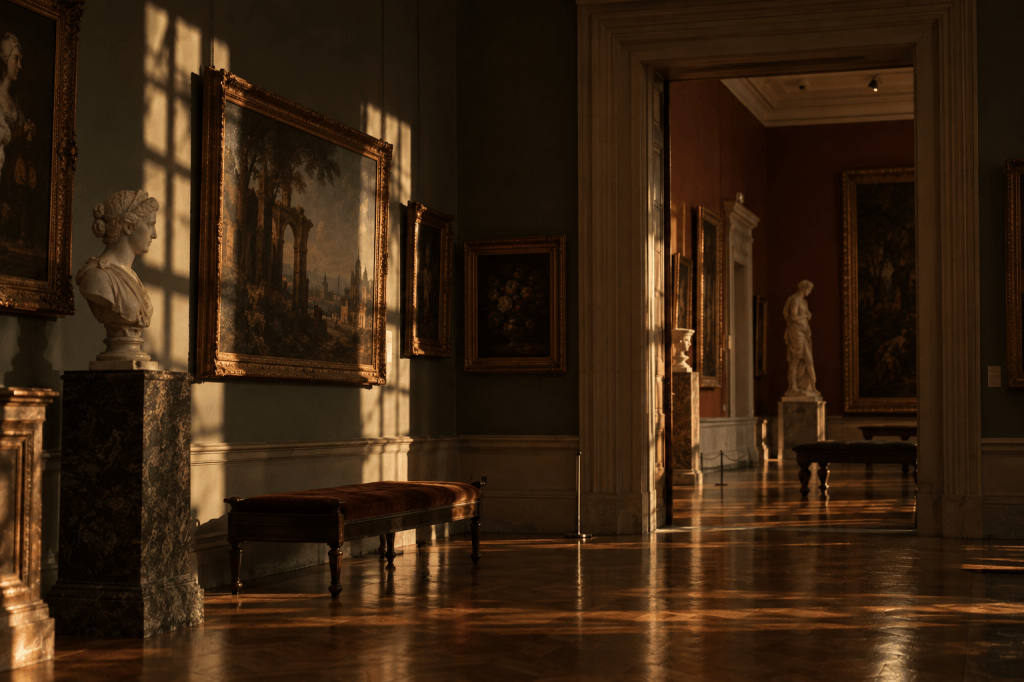
The Metropolitan Museum could hardly be a more fitting place for Daphne and Eddie to find one another again. A museum is, among its grander purposes, an exquisitely organised testament to human beings’ refusal to grant disappearance the final word. The maker dies, the household vanishes, an empire eventually dwindles into a paragraph in a schoolbook, while a bowl survives beneath glass and a painted face continues to meet the eyes of strangers under carefully controlled light. Long after the world that produced these things has gone, somebody has decided that the evidence left behind deserves another room, another century and the continued attention of people who can never fully recover the lives from whence it came.
When Eddie and Daphne return to the Met near the end of the novel and he remarks that “people are art,” the sentence seems almost modest beside everything that has gathered around it. The book has been constructing a private museum of its own all along, filled with accidents, photographs, dictionaries, second marriages and old scars; the lives within it are preserved through the objects they leave behind and through the memories held for them by other people, including memories of selves they have long since ceased to recognise.
Eddie spends his illness reading The Tibetan Book of the Dead and speaking earnestly about impermanence, while his lifelong desire to give shape and order to experience remains undiminished. He tells Daphne that she should write a book and that he will edit it, and between them they will arrange Mary Carter, Whistler, the raspberry farm, the accident, the snow, the people who went away and those who returned after many years. His acceptance of death is sincere, though it exists beside an equally sincere wish to leave something unfinished between himself and Daphne, a work through which their conversation might continue and in which the scattered portions of their common history could be brought together while there was still time for him to help her understand them.
He has spent a lifetime imposing sequence upon the abundant disorder of other people’s stories, deciding what belongs, what may be removed and where one thing should follow another; as his own days narrow, he turns once more towards the work by which he has always made experience comprehensible. The proposed book cannot prevent his death, though it gives him one final act of attention and allows him to enter Daphne’s future understanding of their past, which may be the nearest form of continuance either of them can honestly imagine.
And so Whistler turns backwards into 1980, returning us to the aftermath of the accident, when Eddie is young, Daphne is nine, with an entire lifetime ahead of them. The manoeuvre is visibly constructed, and a sterner reader might object that the novel has persuaded life into a symmetry it seldom possesses; I could see exactly what Patchett was doing and remained moved by it, because the return to the accident does not erase our knowledge of all that will follow. Eddie will leave, forty-four years will pass, Daphne will grow older, and the young man holding her hand in the ambulance will become the dying man who asks her to write their story, though the novel closes before any of this has yet entered the world surrounding them.
Afterwards, one begins to understand how readily memory performs a similar movement, taking one afternoon and slowly turning it into the afternoon because everything following it has taught us how to look backwards. A horse’s return comes to explain something a child could not yet have named; one object is carried from house to house while another, equally useful, is given away; we frame photographs, save dictionaries, build museums, empty our parents’ cupboards and pause over things of no imaginable use because their value belongs to a history which cannot be separated from them. Whole years disappear while a few objects, names and moments remain, and from those surviving fragments we attempt to understand the lives through which they passed.
What Whistler finally offers is another interval of attention, limited and temporary, though no less meaningful for being so. Daphne’s book cannot restore Eddie, and neither can recover the forty-four years through which they lived without one another. But it can preserve something that would otherwise disappear with the person who remembered it. Eddie spends his final months learning that everything must move forward and that even those most beloved to us are subject to the ordinary indignity of ending, while Patchett listens to this wisdom and then turns away before the old man reaches his death, searching through forty-five years for the younger one he has long since ceased to be.
She finds him in an ambulance, Daphne’s small hand held in his own, with the terror behind them and almost everything else- the marriage, the disappearance, the museum, the books, the illnesses, and Whistler’s photograph, still waiting beyond the reach of either imagination; and she leaves them there together while, outside the glass, the snow continues to fall over the wrecked car, the dark road and the whole unspent, unwritten life lying ahead of them.
Written by Nishat A. Hossain, a writer and reader interested in classics, contemporary fiction, reading culture, and the ways through which old stories continue to shape the present.


Leave a Reply