The Love Hypothesis began as Star Wars fanfiction; five years, millions of readers and a film adaptation later, it belongs to a publishing world that has finally discovered how much literary life was flourishing beneath usernames.
Fanfiction was, for a long time, something many readers encountered privately and spoke about selectively. It could occupy an astonishing amount of your reading life without ever quite entering the respectable account of that life, and it did not enter the list of books you mentioned when asked what you had been reading or the authors you recommended. Somewhere alongside all that, often on a phone or laptop and under the cover of a username, people were reading hundreds of thousands of words about characters they already knew, following unfinished stories for months, arguing over pairings and endings, and becoming deeply attached to work that scarcely seemed to belong to the same literary world as the books being reviewed, bought and discussed elsewhere.
Fanfiction belonged somewhere else. Not quite beneath literature, perhaps, because that gives the arrangement more dignity and coherence than it ever possessed, but off to one side of it, behind a curtain the respectable reader might occasionally slip through and then draw carefully closed again. Published books had covers, acknowledgements, reviews in newspapers and authors whose names appeared in sober type above their titles. Fanfiction had usernames, tags, comments written at indecent hours and readers threatening, with considerable affection, to perish if the next chapter did not arrive soon.
It is a little difficult to preserve that old hierarchy when one of those stories is about to arrive on Prime Video. The Love Hypothesis, Ali Hazelwood’s 2021 novel about a doctoral student, Olive Smith, who finds herself entangled in a fake relationship with the famously forbidding professor Adam Carlsen, will be released as a film on 23 September, with Lili Reinhart and Tom Bateman in the principal roles. By now the book itself scarcely requires introduction within romance-reading circles. Its illustrated cover has spent years appearing on bedside tables, airport shelves, Instagram photographs and those formidable BookTok stacks in which six novels are apparently considered a modest weekend provision; it spent months on the New York Times bestseller list and helped make Hazelwood one of the most recognisable names in contemporary romance.
Adam and Olive, however, were not always Adam and Olive. Once, before the publishers and film rights and neat rows of finished copies, there were Rey and Kylo Ren.
Hazelwood originally wrote the story that would become The Love Hypothesis within the Reylo fandom, the vast online community that grew around the relationship, imagined or otherwise, between Rey and Kylo Ren in the Star Wars sequel films. The story was later substantially reworked for publication, the borrowed world taken away and another put in its place, until the space opera had become academia and the strange, charged antagonism of the original pairing had survived mostly as a faint outline beneath a contemporary romance.
There is something very fascinating about the route the story has travelled. A film inspired a fanfiction; the fanfiction became a novel; the novel became a bestseller; and the bestseller has now become a film again, returning to the screen after a long circuit through the imagination of somebody who once simply wished the original screen story had gone differently.
The internet did not invent the dissatisfied reader, and literature would look rather thin without people taking possession of stories that belonged, technically speaking, to somebody else. Myths have always been retold by people; Shakespeare plundered plots with an ease that would send a modern copyright department into hysterics; generations of writers have answered earlier novels, borrowed their characters, corrected their silences, moved minor figures into the centre and occasionally written entire books because another author’s ending continued to irritate them.
Fanfiction is not identical to any of those traditions, and the legal difference matters, particularly in an age of vast entertainment franchises whose characters remain protected intellectual property. And yet, the imaginative appetite is recognisable enough, and some readers reach the final page or watch the credits rise and remain unfinished with the story, and begin to write another one.
For many years this sprawling world of reader-writers could be dismissed precisely because it did not look much like the literary world as respectable institutions understood it. It was too amateur, too emotional, too enamoured of romance, too willing to linger over relationships that the original work had treated as incidental. It was written disproportionately by women and young people, which has never been an especially reliable route to instant cultural gravity. There were excellent works buried beside dreadful ones, beautifully constructed novels-length stories beside fragments abandoned after four chapters because somebody had examinations, a new job, a broken heart, or simply ceased to care whether Draco Malfoy was capable of redemption.
Nothing had passed through an acquisitions editor, and nobody had promised quality. Yet the readers came anyway. That fact, which for a long while seemed culturally embarrassing, has become commercially difficult to ignore. The Love Hypothesis is now merely one particularly visible member of a much larger migration. SenLinYu’s Alchemised, published by Del Rey, began its life in another famous fandom, as the Harry Potter fanfiction Manacled, a dark and enormously popular story centred upon Hermione Granger and Draco Malfoy. By the time Alchemised reached bookshops, its old architecture had been pulled apart and rebuilt into an original fantasy world, although many thousands of readers already knew the story’s earlier incarnation intimately. The publishing deal was enormous, the anticipation before publication extraordinary, and film rights followed.
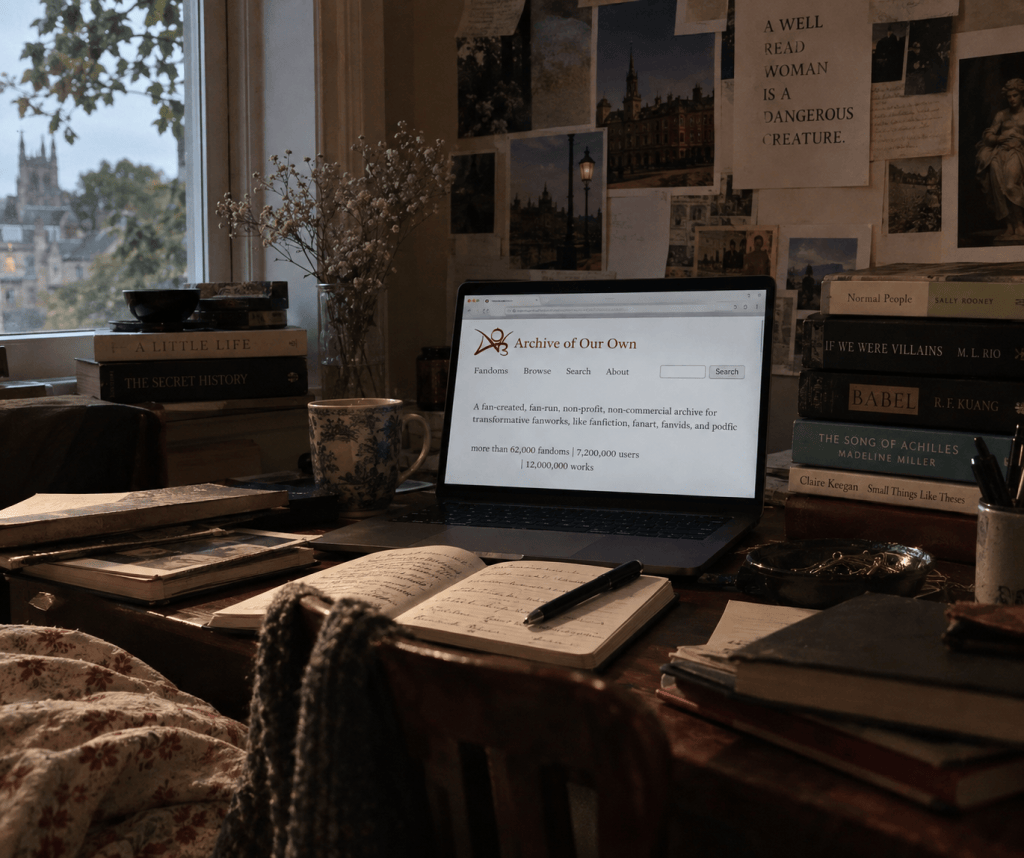
Elsewhere, agents and editors have begun speaking much more openly about fanfiction communities as places in which writers, audiences and commercially potent ideas may already be gathering long before traditional publishing notices them. AO3, Wattpad, BookTok and self-publishing no longer sit beyond the publishing industry, and one can understand why.
Publishing is, after all, a business of expensive uncertainty. A manuscript arrives. An editor loves it. An acquisitions team must then decide whether several thousand strangers, who have not yet seen the thing, might love it too. Covers are designed, advances paid, copies printed, publicity arranged, and then the doors open and everybody discovers whether the imagined reader exists.
Fanfiction is different because it arrives trailing actual readers behind it. A story that has been read hundreds of thousands of times has already survived a test that an unpublished manuscript has not. People have searched for it, recommended it, left comments beneath it, waited for updates and discussed its characters in other corners of the internet. Some have read it twice. Some have produced fan art for a work that was itself fanfiction. The audience has made itself visible before the publisher has spent anything trying to summon it.
And BookTok, of course, has made visibility an even more valuable form of currency. Its importance to publishing has long since passed the stage at which it could be treated as a charming oddity. Books that appeared years earlier have returned to bestseller lists because readers rediscovered them there and unknown writers have acquired audiences at extraordinary speed. Terms such as enemies to lovers, forced proximity, one bed and morally grey now signal an entire range of expectations before a reader has encountered the setting or characters. Fanfiction communities understood this language long before publishing departments began displaying these tropes prominently.
Indeed, one of the pleasures of watching the two worlds draw closer has been seeing practices once associated with fanfiction appear in commercial publishing. Readers have always used tags to find the emotional experience they wanted and now novels are sold by tropes. Fandoms organised themselves around relationships and now publishers build campaigns around ships and character chemistry.
Fanfiction is also rather different because its writers have always worked unusually close to their readers. Where a novelist who was published in the ordinary way may spend months or years writing in solitude before encountering the response to a finished book, a fanfiction writer can post a chapter on Tuesday evening and wake on Wednesday to fifty people discussing a sentence she wrote at her kitchen table. There are advantages to this and horrors too, I imagine; no writer in history ever became more serene by gaining immediate access to everyone else’s opinion. Yet something curious happens inside that closeness, and writers come to learn and understand their readers: where attention falters, which characters provoke devotion, how long tension can be stretched before pleasure turns into annoyance. None of this necessarily creates good literature (Popularity has never been an infallible aesthetic judgement). Still, it is a kind of apprenticeship, however unconventional.
The old image of fanfiction as people clumsily imitating the works they adore misses how often writers use borrowed characters because borrowing frees them to practise everything surrounding them: pacing, dialogue, longing, suspense, point of view, etc. The furniture has been supplied, so they rearrange the room to discover what happens, and after several years, realise that they would rather build a house of their own. And now publishing has begun buying some of those houses.
There is a less picturesque aspect to all this, naturally, and perhaps it is worth lingering there because the transformation of fanfiction into a hunting ground for publishing cannot be explained entirely as the overdue recognition of neglected talent. Some of literature’s loveliest books begin without anybody asking for them. Their audiences cannot always be measured in advance because the writer is offering something readers do not yet know they want. If publishing becomes excessively fond of manuscripts with visible audiences attached, one wonders what happens to the peculiar, difficult, solitary book whose future readership exists only as an editor’s hunch. What becomes of the novel without an aesthetic, a fandom or an attractive number sitting beneath an author’s profile picture?
But I do not think that anxiety quite cancels the other thing that has happened here, which is rather more democratic and, to my mind, more interesting. Readers have now come to acquire a little more power over the route by which stories become culturally important.
For most of the history of modern publishing, formidable gates stood between writing something and persuading thousands of strangers to read it. Agents, editors, booksellers and newspaper critics decided what would reach the public and how prominently it would be placed when it arrived. But a story can now become beloved before anybody has selected it for publication.
Readers may gather around something first, quietly at the beginning, then in such numbers that an industry accustomed to creating audiences finds an audience already gathered, eager and impatient. The professional machinery arrives later and gives the story a new shape, cover and publicity. Yet the original act of discovery has already occurred among readers who have been there since the beginning.
Perhaps this is why the journey of The Love Hypothesis feels more significant than the film adaptation itself. Most of the people who watch it this September will have no particular reason to care that Adam once bore some imaginative relation to Kylo Ren, or that Olive’s distant foremother was Rey (who, whatever the final film may have tried to persuade us of, is not, has never been, and by every law of sense and genealogy never will be a Skywalker). And perhaps, by then, it scarcely matters, because the borrowed names are gone, and the story has long since learnt how to live without the world that first lent it a shape.
What remains is the far stranger fact of how it got there. For years, fanfiction existed in the margins of literary culture, written beneath pseudonyms, passed from reader to reader, and adored with an intensity the respectable book world occasionally found embarrassing. Yet those margins were full of people learning to write, learning to read one another, learning what they wanted from stories and, without intending to, building enormous communities around desires the publishing industry had not yet quite learnt to measure.
Perhaps that is the real change hidden inside the cheerful improbability of a Reylo fanfiction becoming a bestselling romance and then returning to the screen. The great gatekeepers have not vanished, nor would literature necessarily be improved if they did; but somewhere along the way, readers ceased merely to wait at the far end of publishing to discover what they had been given. They began gathering around stories first, loving them before anybody had formally authenticated that love, and carrying some of them so far that eventually the publishers, the bestseller lists and the film studios had little choice but to come looking. And just like that, Fanfiction finally became too large a world for the gates to keep pretending it was outside.
Written by Nishat Hossain. I write about books, culture, art and ideas, and the questions that make each of them interesting. For commissions and collaborations, visit my Work With Me page.


Leave a Reply