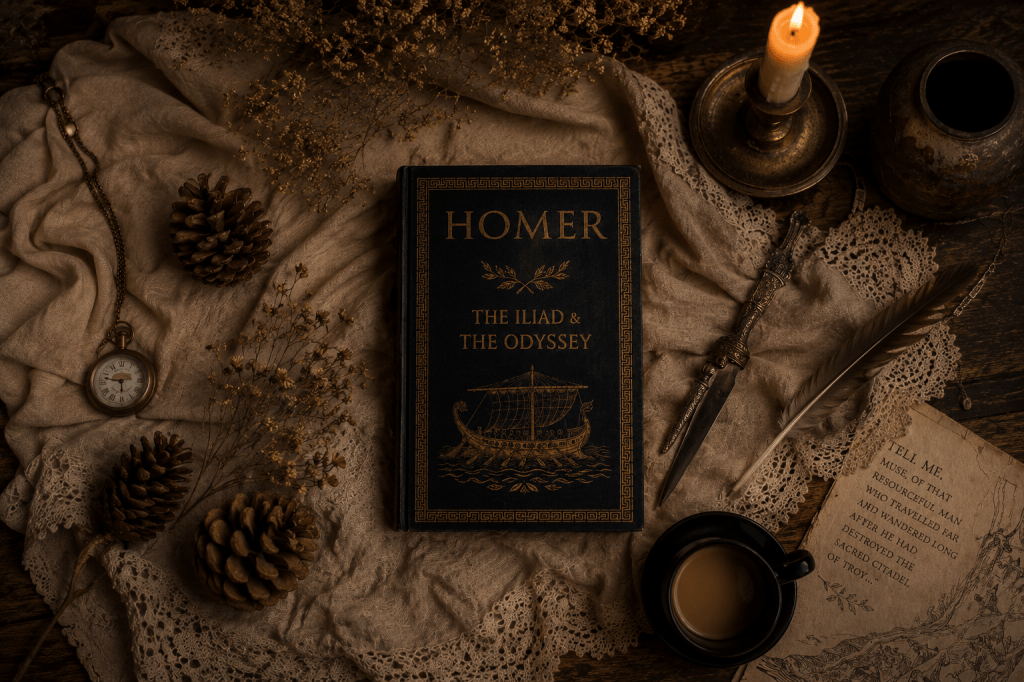
How a Hollywood blockbuster sent readers back to Homer, and what it reveals about the strange afterlife of the classics.
There is something faintly delightful about walking into a bookshop in 2026 and discovering that one of the most sought-after books in the room was composed nearly three thousand years ago.
Homer has had, by any reasonable standard, an excellent summer.
Since Christopher Nolan’s The Odyssey arrived in cinemas in July, bringing with it Matt Damon, monsters, shipwrecks, gods, an enormous IMAX camera and the sort of publicity campaign usually reserved for superheroes, readers have begun drifting in the opposite direction from the one cultural pessimists have spent years predicting. Instead of abandoning the book for the screen, they have left the cinema and gone looking for the book.
The figures are sufficiently extravagant to sound almost Homeric themselves. Print sales of The Odyssey in Britain rose by 1,400 per cent during the four weeks surrounding the film’s release; in the United States, sales across all editions are up 76 per cent this year. Emily Wilson’s 2017 translation rose to number two on the overall American bestseller list, selling more than 31,000 print copies in a single week, and remains in the national top ten weeks later. Meanwhile, Nolan’s film has crossed $1.4 billion worldwide and become the highest-grossing film of his career.
For perhaps the first time in a very long while, a person may buy Homer not because a professor has put him upon a reading list, nor because some guilty corner of the conscience believes that civilised people ought eventually to have read the Greeks, but because she has just spent three hours watching Odysseus attempt to get home and would now rather like to know what, precisely, Homer thought he was doing, which is is a small distinction, but a rather important one. The classics have never suffered from a shortage of admiration, but they have suffered, occasionally, from rather too much of it.
The Trouble With Being So Very Important
There are books so famous that their fame begins to stand between them and the reader. One approaches The Odyssey already knowing that it is Important. It is one of the foundations of Western literature, its influence running through drama, poetry, fiction, philosophy and nearly every story in which somebody goes somewhere difficult and discovers that returning home will be harder than leaving it. Its characters have escaped the poem so thoroughly that people who have never read Homer know what a siren is, have heard of the Cyclops, recognise Penelope’s patience and understand that an odyssey is a journey likely to involve more inconvenience than originally advertised. All of this ought to make the book approachable, but curiously, it often does the reverse.
The very word classic can produce a slight stiffening of the spine. A classic is presumed to require preparation. There may be footnotes, there may be genealogies. There may be an introduction of sixty pages which one suspects, with gathering unease, that a responsible reader ought not to skip. Greek epic in particular arrives surrounded by names one cannot pronounce, gods whose familial arrangements are extraordinarily difficult to remember, or even understand, and the lingering memory of schoolrooms in which mythology was presented less as a collection of marvellous stories and more as dry, exhausting information to be crammed for a test.
Then Hollywood comes along, puts a bow in Odysseus’s hand, sends a sea monster after him and reminds everybody of something scholarship, through no fault of its own, occasionally allows us to forget: Homer is tremendous entertainment.
Emily Wilson has made precisely this point when discussing her translation. The Homeric poems were not conceived as rarefied literary objects intended for a silent reader sitting reverently beneath a lamp; they belonged to oral performance, to audiences listening together, and their language had to move and flow. Wilson deliberately chose a clear, rhythmic English because she wanted to restore something of that propulsive quality rather than coat the poem in an artificially “epic” grandeur. Once one remembers this, the alleged strangeness of Homer becoming a popular sensation begins to disappear.
The Odyssey contains storms, witches, monsters, cannibals, shipwrecks, seduction, disguises, murder, revenge, a marriage under extraordinary pressure and a hero sufficiently complicated to have kept scholars disagreeing about him for several millennia, while Odysseus lies beautifully, cries frequently, makes disastrous decisions, survives largely through intelligence and charm, and returns after twenty years to discover more than a hundred men eating his food and attempting to marry his wife—so one can see why both cinema and readers might be interested.
Sometimes We Need Permission to Simply Enjoy the Classics
What the film has supplied, more than information, is permission. There is a peculiar psychological difference between being told that one ought to read a classic and discovering that one wants to know what happens next. The former approaches literature through duty; the latter through appetite, and appetite has always been the more reliable companion over several hundred pages.
BookTok has noticed the change almost immediately. Creators have produced primers on Greek mythology for people heading to Nolan’s film, compared translations, debated the characters and begun recommending other classics and mythological retellings; The Bookseller reported a surge in Odyssey content alongside a broader enthusiasm for Greek literature which had previously occupied a quieter corner of the platform. There is something rather lovely about this because it reverses the usual story told about contemporary attention. We are accustomed to hearing that spectacle is replacing literature, that screens are destroying long-form reading and that younger readers will choose almost anything before an ancient poem of nearly six hundred pages. Instead, one of the largest spectacles of the year has become an advertisement for exactly such a poem.
Perhaps much of what we call difficulty in the classics is therefore not difficulty in the books themselves but difficulty in the manner of our introduction. A reader who encounters The Odyssey as “one of the canonical texts of archaic Greek literature” has been given a responsibility. A reader who encounters it as the story of a clever, morally troublesome man trying for ten years to get back to a wife who has meanwhile spent ten years outwitting her unwanted suitors has been given a story. The book is the same but the doorway is different.
And Then the Film Fails the Book, Which May Be Even Better
There is another, more amusing reason people have gone back to Homer: Nolan’s Odyssey has not settled the meaning of the poem at all. Emily Wilson, whose translation Nolan himself cited as an influence, disliked the adaptation intensely. She criticised its characterisation, narrative choices and treatment of the poem’s moral and emotional complexities, arguing that much of what makes Homer fascinating had been flattened in the passage to blockbuster cinema. Other classicists have raised similar objections, particularly over the transformation of Odysseus and the film’s treatment of Penelope, the gods and the aftermath of war.
And yet Wilson has also welcomed what the film has done for Homer’s readership. This apparent contradiction is really no contradiction at all. An adaptation does not have to replace its source in order to serve it; in some cases, failing to contain the book may be its greatest usefulness. A viewer leaves the cinema having encountered one Odysseus and discovers almost immediately that readers, translators and classicists are arguing about another. Was he heroic? Selfish? Clever? Cruel? Was Penelope merely waiting for him, or governing a household under siege with a cunning equal to his own? What has Nolan altered? What did Homer mean by the Greek word Wilson rendered, famously, as “complicated”? Suddenly the ancient poem is not an answer waiting in a library. It is an argument, and arguments are wonderfully enlivening things for old books.
The week Wilson’s translation reached number two in America, Robert Fagles’s older translation rose sharply as well; sales of Madeline Miller’s Circe and The Song of Achilles leapt alongside Homer. Readers were not merely purchasing a souvenir of the film. They were wandering outward through translations, retellings and related texts, which is exactly what happens when curiosity has replaced obligation. The imperfect adaptation may therefore do something the perfectly reverent one cannot: it creates friction, which in turn fuels curiosity in the reader to know what was changed.
We want the scene the film omitted, the character it simplified, the moral ambiguity it tidied away. We discover that there is no single Odyssey waiting behind the cinema version, because even the English translation we’ve picked up is itself the result of somebody making thousands of choices about rhythm, tone, violence, gender and meaning. And so the road back to Homer turns out to contain several Homers.
Translation Is Its Own Kind of Time Travel
The present Odyssey boom is particularly revealing because the bestselling book is not, strictly speaking, the same object that ancient Greeks heard performed.
Almost every English-speaking reader encounters Homer through another mind, and Emily Wilson’s translation has become central to the present revival precisely because it does not pretend that translation can be invisible. Published in 2017, it was the first complete English translation of The Odyssey by a woman, and Wilson deliberately made choices which differed from long-established versions: regular iambic pentameter, comparatively direct diction, careful attention to the social hierarchies and enslaved people whom earlier translations sometimes softened, and a refusal to inflate Homer’s language merely because English readers expect ancient epics to sound grand. The result has often been described as unusually accessible, though the word can be faint praise when applied to literature, as though clarity were a charitable concession made to readers of limited stamina. Wilson’s achievement is more interesting than simplification. She reminds us that The Odyssey was always meant to move.
And now, in a wonderfully appropriate development, she is translating it again. Wilson has said that she wants to revisit choices in her enormously successful version and produce a fuller, more nuanced new translation, an unusual decision for a translator whose first attempt has become one of the defining versions of the poem in English. Even the translation which helped make Homer new again is not being treated as final. There may be no better illustration of how classics remain alive.
What Hollywood Is Really Giving the Classics
It is very easy, especially for people who love books, to be suspicious when Hollywood turns towards them. There are good reasons for this: films simplify what they adapt. Complicated characters become easier to market once somebody has decided whether they are heroes or villains, while quiet interior conflicts have an unfortunate tendency to acquire explosions when sufficiently large budgets become involved. The reader who has loved a novel for years approaches its adaptation with much the same mixture of hope and proprietary anxiety with which one might watch an old friend marry somebody unsuitable.
However, the choice is not always between a pure book and a corrupted film; sometimes that film can be an invitation. Many readers first arrive at Austen because somebody cast an excellent Darcy. Others meet Louisa May Alcott through a cinema screen, Shakespeare through an actor, Dickens through Christmas television, Greek myth through Madeline Miller or Rick Riordan. Once inside, they are perfectly capable of discovering that the original is stranger than the adaptation, less obedient, more difficult in some places and more alive in others.
Indeed, the evidence of this summer suggests that popular culture does not necessarily cheapen the classics by making them popular. Homer was not written for an examination paper. He belonged to voices, audiences, suspense, repetition, performance, laughter, horror and the communal pleasure of hearing a familiar story told once more, a little differently. That may be why the present spectacle of young readers buying The Odyssey after leaving an IMAX theatre feels less like an indignity than a homecoming. They have been brought to a very old book by very modern means, and perhaps there is nothing particularly strange about that. Odysseus himself spends most of his poem reaching familiar places by improbable routes.
There will, inevitably, be readers who buy Homer because Nolan has made him fashionable and never reach the final page. There will be copies abandoned after a few chapters, forgotten on bedside tables, or acquired in an optimistic burst and allowed thereafter to gather the dignified dust so peculiar to unread classics. It’s alright. Books have survived worse.
But there will also be readers who came for the Cyclops and stayed for Penelope, who discover that the poem they expected to be remote is full of grief, longing, vanity, hospitality, cruelty, storytelling and that most ancient of human desires: after wandering through everything the world can put in one’s way, to recognise the place where one belongs.
Hollywood may have supplied the ticket, but Homer, rather like Odysseus, has taken the longer route home.
Written by Nishat Hossain. I write about books, culture, art and ideas, and the questions that make each of them interesting. For commissions and collaborations, visit my Work With Me page.


Leave a Reply