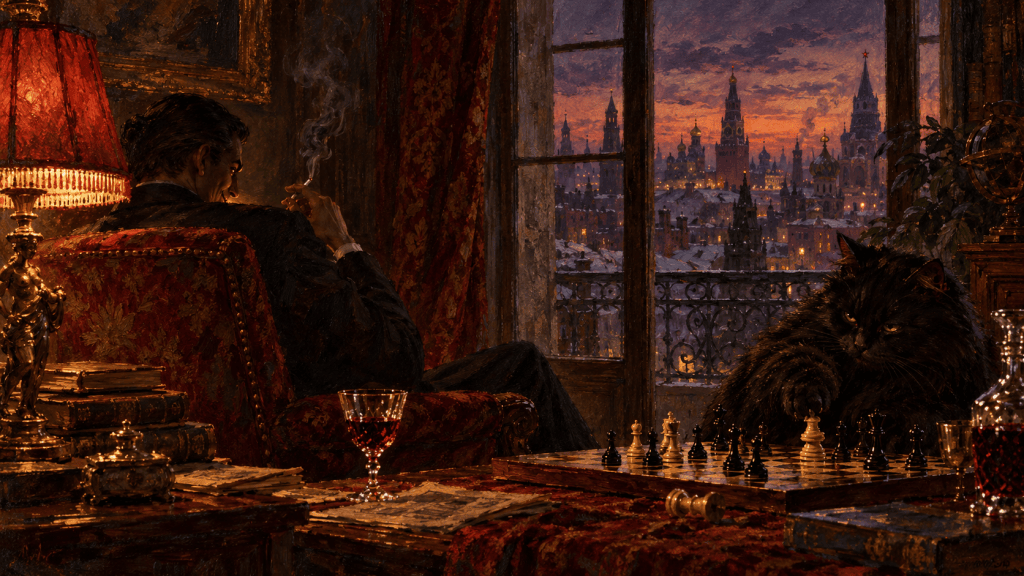
One rather expects the Devil to make an entrance. Woland has mismatched eyes, a crooked mouth, an expensive grey suit and the unfortunate habit of arranging for people to lose their heads. There are men in literature whose personal shortcomings may be overlooked in consideration of their other qualities, though being Satan himself is perhaps a little beyond the usual concessions one makes for charm. Still, Bulgakov has given him such magnificent composure, such an exquisite appreciation of human stupidity, that I am prepared to overlook a great deal. The Master, meanwhile, is a suffering artist, a persecuted intellectual and one half of the great love story promised by the novel’s title. I ought to be considerably more interested in him. Yet whenever I return to The Master and Margarita, I find myself growing impatient for Woland to reappear, preferably accompanied by that revolting cat of his.
His first appearance at Patriarch’s Ponds is magnificent. Berlioz and Ivan are discussing the historical existence of Jesus with the comfortable assurance of gentlemen who have never had their opinions challenged by an eyewitness from the supernatural world. Woland interrupts, asks a few questions, and proceeds to describe Pontius Pilate’s encounter with Yeshua as though recalling a rather unpleasant afternoon spent abroad. Berlioz grows increasingly agitated. Woland seems to enjoy himself enormously, particularly when the conversation turns towards the approaching tram and Annushka’s unfortunate sunflower oil. I should have stayed to listen, though I hope I would have known when to make my excuses.
The Master, rather more deserving of sympathy, doesn’t appear until Chapter Thirteen. Margarita keeps us waiting until Chapter Nineteen, by which time I have become so thoroughly accustomed to Woland’s company that the lovers seem almost like late arrivals at their own dinner party. Poor Master. He has written a novel, been tormented by critics, burnt his manuscript, and made himself ill with despair, while the Devil has been gallivanting around Moscow arranging calamities. It is an unfortunate comparison, though Bulgakov can hardly have been unaware of it. He gives the most entertaining person in the book to the forces of darkness, then expects us to turn our attention to a melancholy gentleman in a hospital gown.
And the really outrageous thing is that Woland has been telling the Master’s story before the Master himself appears. The account of Pilate and Yeshua begins at Patriarch’s Ponds, apparently related by the Devil, who claims to have witnessed the events. Later Ivan dreams another portion of it. The manuscript has acquired a life quite independent of the poor fellow who wrote it, slipping through the novel with an almost indecent disregard for authorship. Imagine labouring in secret over a book, suffering a nervous collapse over its reception, and discovering that Satan has been giving readings from it at a public pond. Without permission, naturally. Though he does at least appear to have understood it, which is more than one can say for the critics.
The literary gentlemen of MASSOLIT have been making much more satisfactory arrangements for themselves. There are cottages, privileges, professional positions, and the restaurant at Griboedov House, where the food is described with such loving particularity that my mouth waters every time I read about it. Bulgakov has a tremendous weakness for food, or at least for describing it, and I rather admire his refusal to make the establishment unappealing merely because its patrons are ridiculous. I should probably have wanted a membership card myself. It is difficult to remain sternly devoted to artistic integrity in the face of good sturgeon.
Still, I cannot imagine a place less suited to Woland and his companions, particularly Behemoth, whose behaviour suggests that the supernatural world has been unusually negligent in its standards of upbringing. He cheats at chess, carries a revolver, quarrels with strangers and possesses a primus stove of which he is altogether too fond. The stove troubles me more than the pistol. It is such an intensely domestic object, the sort of thing one associates with cramped kitchens and the smell of supper, and here it is being carried about by a monstrous cat with a taste for arson. At the Torgsin shop he devours mandarins without troubling to remove their peels. He is a creature of apparently limitless infernal possibilities, and his ambitions run largely towards groceries and making a nuisance of himself.
Woland, meanwhile, hardly needs to exert himself. At the Variety Theatre he sits watching while Koroviev and Behemoth distribute money, conjure up Parisian clothes and make an increasingly dreadful exhibition of the compère Bengalsky, whose determination to explain every trick becomes intolerable. I wanted him to be quiet myself. Behemoth obliges by tearing off his head.
Well, that was rather more than I had in mind.
The audience is horrified, eventually, and begs for the head to be restored. Woland watches with the air of a mildly interested visitor studying local customs. His subsequent observations about human beings are wonderfully peculiar. They love money, as they always have; occasionally they are capable of mercy; the housing shortage has done them no favours. That last observation delights me. Here is the Prince of Darkness, who has presumably observed the rise and fall of empires. He has come to Moscow to consider the eternal condition of the human soul and has apparently developed opinions about municipal accommodation. Yet it is difficult to disagree with him. Everybody in this wretched city seems to be fighting over an apartment.
His victims are often insufferable. So are most of us, in small, unimportant ways, and I doubt we would look attractive under the same sort of scrutiny. Woland need never worry about consequences, which is one of his most seductive qualities until you remember what consequences are for. I keep admiring his composure anyway. Then Behemoth says something disgraceful and my conscience, which had begun clearing its throat, is obliged to wait.
Woland is courteous when he wishes, given to sudden and rather alarming intimacies, and speaks with the authority of somebody who knows exactly how every conversation will end. Other people become flustered in his presence. They explain themselves, contradict themselves, try desperately to preserve whatever small dignity remains to them. Woland needn’t raise his voice. The unequal eyes, the occasional smile, that faint suggestion that he is amused by something the rest of us cannot see: Bulgakov has made him terribly compelling. I don’t even think he is meant to be handsome, but it scarcely matters.
His dealings with Margarita are especially interesting, perhaps because she refuses to become merely another ridiculous Muscovite for his amusement. She has spent too long waiting, wondering, grieving; when an opportunity comes to fly over Moscow as a witch and exact revenge on the critic Latunsky, she takes it with both hands. The flat is wrecked. Windows, furniture, plumbing: nothing escapes. I am sorry for the piano, which never reviewed a manuscript in its life, but I enjoyed the smashing disgracefully. Then she hears a frightened child and stops. Bulgakov lets the change happen without a great deal of ceremony. Margarita is furious, and then she sees someone frightened, and her fury ceases to interest her quite so much.
At Satan’s ball she conducts herself admirably among a collection of guests whose social histories would make even the most accommodating hostess reconsider her invitations. Afterwards, exhausted and desperate to recover the Master, she must negotiate with Woland.
When Margarita is offered her reward, she remembers Frieda, whose punishment has moved her to pity, and asks that the woman be spared her nightly torment. I wonder whether Woland expected that. I had been admiring the Devil’s exquisite detachment; suddenly the woman who spent the evening serving at his monstrous party seems much more formidable. She has been afraid all night. It hasn’t stopped her attending to someone else’s misery. Woland may know everybody’s secrets, but sometimes I wonder what he makes of people who surprise him.
I have neglected Pilate, which is what happens when one gets carried away with Satan. The procurator has an atrocious headache, the smell of rose oil makes him ill, and he is trying to discover some way of sparing Yeshua without offending the authorities above him. There is no elegance in his fear. It makes him fretful, calculating, sick with himself. Woland would never be cornered in that fashion, though it costs him nothing to be fearless. He exists outside the humiliations that undo ordinary men. I don’t know whether Pilate deserves my pity; I know his headache has remained with me, along with his cowardice, more stubbornly than all the dazzling tricks in the theatre.
Even Woland has his limits. Levi Matvei arrives with a request concerning the Master, who is to receive peace rather than light. Woland hears him out, with an air I can only describe as magnificently irritated. For a creature who has spent the novel knowing things before everybody else, he occupies a curiously uncertain position in its last arrangements. I rather like that Bulgakov doesn’t explain it to my satisfaction. Woland would probably despise a reader who needed the entire universe laid out in a tidy diagram.
I still look forward to Woland’s arrival every time I open the novel. I want to hear him talk, watch Behemoth disgrace himself, and see the dreadful little circus set Moscow on its head. The Jerusalem chapters remain with me long after I’ve finished reading, as does the Master’s exhausted surrender, although I confess I tend to remember Margarita most vividly when she is airborne and doing something indefensible. Yet it is the Devil’s departure that I regret with an affection entirely disproportionate to his merits. I would have liked another chapter with him, another conversation, perhaps another one of those dreadful theatrical entertainments. Bulgakov leaves me wanting more of the very person I ought to have learnt to distrust. I should dearly like another evening in his company, though perhaps somewhere other than my own house. I have a great deal of affection for my furniture, and I wouldn’t trust Behemoth within ten feet of the kitchen.
Written by Nishat Hossain, writer and editor of Moorland & Mayfair, with a particular fondness for classics, literary oddities and fictional characters of questionable respectability.


Leave a Reply